
6 FOUNDRY BUSINESS PARK
Seager Road Faversham Kent ME13 7FD
01227 467876
Nationwide Sales & Support
Mon - Fri: 9:00 - 17:00
Sales Office & Service Team
Seager Road Faversham Kent ME13 7FD
Nationwide Sales & Support
Sales Office & Service Team
Activated Carbon Filters by Dena. Dena has various technologies for the purification of VOCs (VOCs) in this category some products are presented. The available technologies allow the complete reduction of low, medium and high concentrations of VOCs until the most stringent limits required are reached.
The main sectors in which they are used are the chemical and manufacturing sectors (e.g. paint industries, degreasing of the mechanical industry, rubber processing industries). Wherever there is a need to reduce solvent emissions from chemical processes that flow into the air.
Design, production and installation of activated carbon filters. Activated carbon filtration is based on an air purification technology that removes pollutants from a stream of gas (or air) by passing it through an ” activated carbon ” filter. This process occurs thanks to the ability of activated carbon to “adsorb” (i.e. retain) most pollutants, which are usually organic.
These organic pollutants can then be further extracted using a “vehicle” which is generally steam or nitrogen.
The activated carbon filter is mainly made up of carbon of vegetal or mineral origin. This is characterized by high porosity and can be found both in powder and granules.
The operating principle is based on a physical phenomenon. As such the molecules of the adsorbed substances are retained inside the pores of the coal by weak Van der Waals forces. All whilst the colloidal particles are deposited on the surface of the coal itself.
The air flow containing the pollutants is then sucked in by one or more fans. Downstream of which there is (usually) a filter that protects the carbon and an “air conditioner” that optimizes humidity and temperature.
Carbon is usually installed in two filters, one of which works actively and adsorbs pollutants (and allows already clean air to be expelled from the chimney). The other is in the regeneration phase immersed in a flow of steam and nitrogen.
Finally, the “dead sorbate” is condensed and recovered in a special section. This can be equipped with a distillery that separates the various components.
This cycle cannot last indefinitely, because at a certain point the carbon becomes exhausted. Therefore it must be physically extracted from the filters and then disposed of in landfill.

The activated carbon filters model Comby is used for air purification and extraction system. Contaning a type of disposable absorber filter, ideal for retaining effluents with high concentrations of Volatile Organic Substances – VOC.
Air purification activated carbon is a highly porous material. Their activity is directly proportional to the surface area of its porosity. The solvent contained in the air to be filtered is then condensed by capillarity and retained in the activated carbon itself. The adsorption capacity is proportional to the surface area and strongly influenced by numerous factors. Such as the concentration of the solvent to be filtered, humidity, temperature, crossing speed, contact time and the particle size of the activated carbon used.
Thanks to its size and cubic construction, the filter , in addition to guaranteeing a high filtration efficiency, guarantees a significant duration of the expected activated carbon charge.
The activated carbon filter model Comby was designed to achieve a crossing speed of 0.3 m/sec and a contact time of 1 second. This operating characteristic is obtained thanks to the insertion of 2 vertical carbon beds inside the cube structure.
The air loaded with VOCs, entering the centre of the filter, expands in the chamber itself. The air is then forced by the fan’s depression to cross the 2 beds of activated carbon, suitably filled, and exit from the two rear side vents. The smaller versions can also be built with a single bed of carbons, while maintaining the impact speed and contact time characteristics unchanged. The air can then be expelled outside via the chimney. The filter is not equipped with pre-filtration, therefore any solid particulates present in the air must previously be retained using other systems.
The activated carbon filter model Comby is made entirely of very thick carbon steel sheet. Suitably worked and treated, to favour its durability over time. The filter is equipped with air inlet/outlet ports, support legs, inspection doors, carbon discharge valves.
Hoist with support structure. Stainless steel executions. Treated coals. ATEX drain valve. ATEX compliance
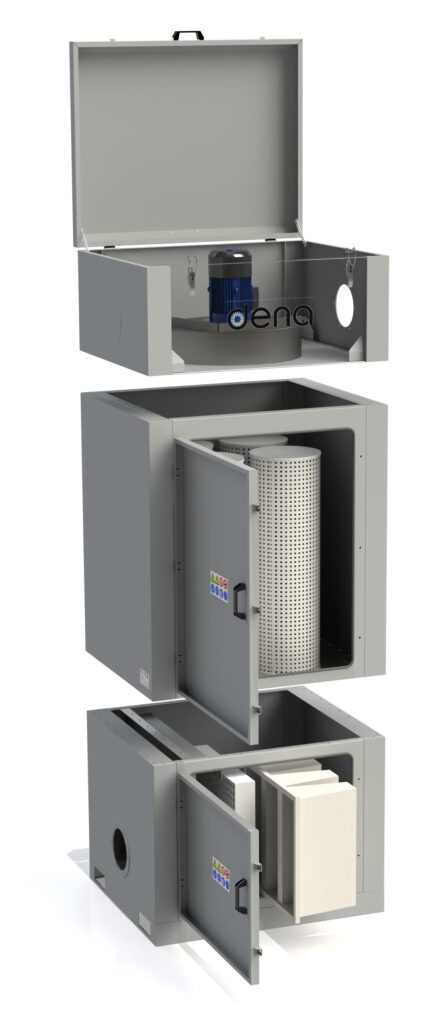
The FC model filter unit (activated carbon filters) is a cartridge filter model and has been designed for the abatement of pollutants containing high concentrations of solvents and particularly volatile particles (ES: VOC – volatile organic substances).
This cartridge filter model, thanks to the large filtering surface and the considerable quantity of activated carbon, allows very long saturation times to be obtained , and in this way the maintenance to be carried out during the year can be planned more easily.
It is made entirely of sturdy press-bent galvanized sheet metal panels bolted together, which form a particularly robust self-supporting structure.
The filter, in the lower part, is equipped with a calming chamber and a first battery of cellulose filters (which are available as optional).
In the upper part, however, there is the battery of activated carbon cartridges for the actual reduction of volatile organic substances (VOS)
The air to be purified is made to enter the lower part of the filter where there is the calming chamber, which has the task of uniformly distributing the air to be purified to the filter system;
subsequently the air passes through the first battery of cellulose fiber filters and finally passes through the battery of activated carbon filters which definitively absorb the polluting substances.
Painting, coating, resining, adhesive, impregnation and lamination operations, lithography of various types of substrates with solvent-based products. Production operations of paints, glues, adhesives, paints and/or similar products with solvents.
Stainless steel executions. Treated coals. ATEX drain valve. ATEX compliance.


Copyright © 2024 Dena AFS UK Ltd. All rights reserved.